 Facebook
 X
X LinkedIn
 Forward
LSART 103: Louisiana Pet Sheltering for Emergencies and Disasters
Course Description:
LSART 103: Louisiana Pet Sheltering for Emergencies and Disasters is the last in a three-course learning series.
The goal of this course is to provide you with a suggested operating guideline for opening, operating, and demobilizing a pet shelter during disasters. It will also cover a working knowledge of the best practices and protocols to shelter people with their pets in a safe environment. This course is designed to provide you with critical information to guide you when assisting agencies with sheltering authority during the sheltering phase. It will prepare you to aid others in developing and executing a sheltering plan for people with pets. You will also gain a working knowledge of the state’s human and pet sheltering process.
Target Audience
Academic Faculty/Staff, Federal Government Employees, State Government Employees, Local Government Employees, Non-Government Employees and Students.
Learning Objectives
- Describe the preparation process in setting up an emergency pet shelter
- Understand who oversees and works at an emergency pet shelter
- Understand the daily operations of emergency pet shelters
- Understand the closing procedures of an emergency pet shelter
- Identify the appropriate forms that are used in an emergency pet shelter
Course summary
- 3.00 Participation/CETulane Professional and Continuing Education (PaCE) awards 3.00 hour(s) of credit for completing LSART 103: Louisiana Pet Sheltering for Emergencies and Disasters
Instructors:
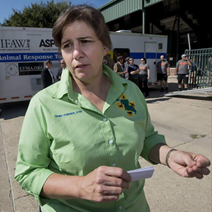
Renee Poirrier, DVM
Dr. Renee Poirrier is the owner of Acadiana Veterinary Clinic, a small and exotic animal private veterinary practice in Lafayette, La. She received her DVM degree from LSU School of Veterinary Medicine in 1988. She was certified in veterinary acupuncture in 1992 by the International Veterinary Acupuncture Society.
She is currently the volunteer director of the Louisiana State Animal Response Team, as well as the statewide unit leader for the Veterinary Medical Reserve Corps. Dr. Poirrier is the Co-Chair of The NASAAEP Evacuation and Transportation Best Practices working group and serves as the Chair of the Louisiana Veterinary Medical Association’s Emergency Management and Disaster Preparedness committee.
As LSART director, Dr. Poirrier has responded to several hurricanes including Hurricanes Katrina and Rita and most recently Hurricane Laura and Ida as well as train derailments and several floods. She assisted state and local officials with developing the current protocols for evacuation and sheltering of pets. She responded to the 2010 Haiti earthquake as an IFAW response partner and oversaw the integration of 214 local Louisiana animal responders over a 5-month period into the 2010 BP oil spill wildlife response.

Suzanne Brevelle
Suzanne Brevelle began her disaster response career as the administrative assistant and grant writer with the Louisiana State Animal Response Team (LSART), in 2016. She continues to work in support of animal emergency response locally, statewide, and nationally as the LSART Administrative Specialist, whose duties include as a technical subject matter expert, providing animal emergency response training for government and non-governmental responder groups and agencies, maintaining the training calendar, volunteer database, finance tracking for response, training, and equipment maintenance support. Suzanne has provided dedicated and experienced support in response to animal emergencies from 2016 to date.

Robbie Averett
Robbie Averett is a retired Planning Section Chief for the Louisiana Department of Agriculture and Forestry‘s Incident Management Team. She has responded at the state level to every disaster in Louisiana from 2005-2022.
She managed the Plans Section of the Emergency Programs Division to support the agency’s State ESF-11 role and responsibilities to support and protect the citizens of the state of Louisiana during disasters. Duties include writing emergency plans, standard operating procedures (SOP), protocols, agency timelines, tabletop and functional exercises, and planning the agency’s role and response during statewide exercises as well as real-time emergency response and support to the overall state disaster response.
CE Credit Instructions:
Upon completion of this course, please email a copy of your certificate to [email protected] with RQST CE Reporting Form in the subject line. In the message, include your name, contact number and the organization (if any) you are affiliated with. Once your request is received, please allow 2 business days for the signed CE Reporting Form to be emailed back to you.
Available Credit
- 3.00 Participation/CETulane Professional and Continuing Education (PaCE) awards 3.00 hour(s) of credit for completing LSART 103: Louisiana Pet Sheltering for Emergencies and Disasters
Price
Required Hardware/software
System Settings
This course is designed to work most effectively if your computer and internet connection meet certain minimal requirements. This course can be accessed using a Windows 10 PC or a Mac with High Sierra1, Mojave, or Catalina. Pop-up blockers should be disabled when viewing the course. Internet Explorer 11 (for Windows 10), or the current version of Google Chrome, Mozilla Firefox, or Apple Safari (for Windows 10 and or Mac) is required. Many of our courses require Java and JavaScript enabled.
Links to External Websites
Links to websites outside this course will open in a new window or tab. Some browsers may minimize the course window. If this occurs, maximize the course window to return to the course.
Adobe Acrobat Reader (for desktops and laptops)
Adobe Acrobat Reader is required to access some documents in this course. If you need to download a free copy of Acrobat Reader, click here.
Internet Connection Speed
A minimum download speed of 1.5 Mbps is recommended for an optimal experience, which is commonly the speed associated with a basic DSL or a cellular/satellite connection. A faster connection, such as cable or fiber service, with further enhance your online experience. A Wi-Fi connection is generally acceptable, but it is dependent upon one of the two services mentioned above. You can check your internet connection speed at http://www.speedtest.net/.